
Questões de Inglês da UNIFESP 2019 com Resolução Inglês Leia o texto para responder às questões de 31 a 35 . Words that de...

Questões de Inglês da UNIFESP 2019 com Resolução
Inglês
Leia o texto para responder às questões de 31 a 35.
Words that define the present
At a time when the world is changing more quickly than ever before, we need a new vocabulary to help us grasp what’s happening.

Catfishing. This word would make more sense if it referred to fishing for cats, but in fact, it refers to people who construct false identities online. Whether out of boredom, loneliness or malice, they lure other people into continued messaging correspondence, thereby building false relationships with them (the apparent source of the term “catfish” is a 2010 documentary called Catfish, whose verity, ironically enough, has been questioned).
There are two ways of looking at this: 1) The internet/cyberspace is wonderful, because it gives people the freedom to augment or totally change their identities, and this is a marvellous new dawn for human expression, a new step in human evolution. 2) Nah, it’s a false dawn, because the internet is essentially a libertarian arena, and, as such, an amoral one (lots of “freedoms” but with no attendant social obligations); it is a new jungle where we must watch our backs and struggle for survival, surely a backward step in evolution. I lean toward the latter.
(Cameron Laux. www.bbc.com, 08.08.2018. Adaptado.)
QUESTÃO 31
(UNIFESP 2019) De acordo com o texto, o termo catfishing
(A) é baseado em um filme com narrativa equivocada.
(B) representa um tipo de jogo entre duas identidades fictícias na internet.
(C) é atribuído a uma plataforma on-line de relacionamentos na internet.
(D) denuncia relacionamentos que estão se tornando essencialmente virtuais.
(E) implica interpretações que podem ser positivas ou negativas.
GABARITO.
QUESTÃO 32
(UNIFESP 2019) According to the first paragraph, new words like “catfishing” are necessary because they
(A) aid older people who may not understand what young people mean.
(B) describe a generational conflict between outdated and new manners.
(C) prove that new behaviours appear and vanish too quickly.
(D) help people to understand transformations in the world.
(E) show that language is not supposed to be stagnant.
GABARITO.

(UNIFESP 2019) De acordo com o texto, o termo catfishing
(A) é baseado em um filme com narrativa equivocada.
(B) representa um tipo de jogo entre duas identidades fictícias na internet.
(C) é atribuído a uma plataforma on-line de relacionamentos na internet.
(D) denuncia relacionamentos que estão se tornando essencialmente virtuais.
(E) implica interpretações que podem ser positivas ou negativas.
GABARITO.
QUESTÃO 32
(UNIFESP 2019) According to the first paragraph, new words like “catfishing” are necessary because they
(A) aid older people who may not understand what young people mean.
(B) describe a generational conflict between outdated and new manners.
(C) prove that new behaviours appear and vanish too quickly.
(D) help people to understand transformations in the world.
(E) show that language is not supposed to be stagnant.
GABARITO.
QUESTÃO 33
(UNIFESP 2019) No trecho do segundo parágrafo “they lure other people into continued messaging correspondence”, o termo sublinhado tem sentido, em português, de
(A) selecionar.
(B) atrair.
(C) desprezar.
(D) conversar.
(E) impressionar.
GABARITO.
(UNIFESP 2019) No trecho do segundo parágrafo “they lure other people into continued messaging correspondence”, o termo sublinhado tem sentido, em português, de
(A) selecionar.
(B) atrair.
(C) desprezar.
(D) conversar.
(E) impressionar.
GABARITO.
QUESTÃO 34
(UNIFESP 2019) O trecho do terceiro parágrafo “we must watch our backs” significa que devemos
(A) enfrentar os desafios de frente.
(B) lutar contra as adversidades da vida.
(C) prestar atenção para não sermos pegos de surpresa.
(D) virar as costas para pessoas desagradáveis.
(E) deixar o passado para trás.
GABARITO.
(UNIFESP 2019) O trecho do terceiro parágrafo “we must watch our backs” significa que devemos
(A) enfrentar os desafios de frente.
(B) lutar contra as adversidades da vida.
(C) prestar atenção para não sermos pegos de surpresa.
(D) virar as costas para pessoas desagradáveis.
(E) deixar o passado para trás.
GABARITO.
QUESTÃO 35
(UNIFESP 2019) No trecho final do terceiro parágrafo “I lean toward the latter”, a expressão sublinhada refere-se
(A) à evolução humana proporcionada pela internet.
(B) ao primeiro item numerado no parágrafo.
(C) ao segundo item numerado no parágrafo.
(D) aos conceitos relacionados à internet e ao ciberespaço.
(E) à internet como espaço de liberdade.
GABARITO.
(UNIFESP 2019) No trecho final do terceiro parágrafo “I lean toward the latter”, a expressão sublinhada refere-se
(A) à evolução humana proporcionada pela internet.
(B) ao primeiro item numerado no parágrafo.
(C) ao segundo item numerado no parágrafo.
(D) aos conceitos relacionados à internet e ao ciberespaço.
(E) à internet como espaço de liberdade.
GABARITO.
QUESTÃO 36
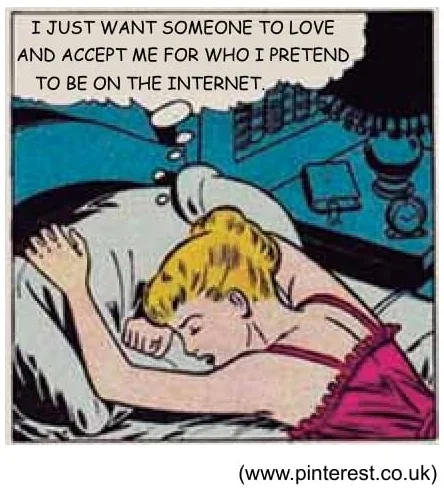
(UNIFESP 2019) The woman
(A) regrets that people accept only her internet identity.
(B) presents herself in an unreal way on the internet.
(C) discovered that her date is catfishing on the internet.
(D) wishes to be like someone she met on the internet.
(E) fell in love with a fake internet profile.
GABARITO.

(UNIFESP 2019) The woman
(A) regrets that people accept only her internet identity.
(B) presents herself in an unreal way on the internet.
(C) discovered that her date is catfishing on the internet.
(D) wishes to be like someone she met on the internet.
(E) fell in love with a fake internet profile.
GABARITO.
Leia o texto para responder às questões de 37 a 44.
Why so few nurses are men

Ask health professionals in any country what the biggest problem in their health-care system is and one of the most common answers is the shortage of nurses. In ageing rich countries, demand for nursing care is becoming increasingly insatiable. Britain’s National Health Service, for example, has 40,000-odd nurse vacancies. Poor countries struggle with the emigration of nurses for greener pastures. One obvious solution seems neglected: recruit more men. Typically, just 5-10% of nurses registered in a given country are men. Why so few?
Views of nursing as a “woman’s job” have deep roots. Florence Nightingale, who established the principles of modern nursing in the 1860s, insisted that men’s “hard and horny” hands were “not fitted to touch, bathe and dress wounded limbs”. In Britain the Royal College of Nursing, the profession’s union, did not even admit men as members until 1960. Some nursing schools in America started admitting men only in 1982, after a Supreme Court ruling forced them to. Senior nurse titles such as “sister” (a ward manager) and “matron” (which in some countries is used for men as well) do not help matters. Unsurprisingly, some older people do not even know that men can be nurses too. Male nurses often encounter patients who assume they are doctors.
Another problem is that beliefs about what a nursing job entails are often outdated – in ways that may be particularly off-putting for men. In films, nurses are commonly portrayed as the helpers of heroic male doctors. In fact, nurses do most of their work independently and are the first responders to patients in crisis. To dispel myths, nurse-recruitment campaigns display nursing as a professional job with career progression, specialisms like anaesthetics, cardiology or emergency care, and use for skills related to technology, innovation and leadership. However, attracting men without playing to gender stereotypes can be tricky. “Are you man enough to be a nurse?”, the slogan of an American campaign, was involved in controversy.
Nursing is not a career many boys aspire to, or are encouraged to consider. Only two-fifths of British parents say they would be proud if their son became a nurse. Because of all this, men who go into nursing are usually already closely familiar with the job. Some are following in the career footsteps of their mothers. Others decide that the job would suit them after they see a male nurse care for a relative or they themselves get care from a male nurse when hospitalised. Although many gender stereotypes about jobs and caring have crumbled, nursing has, so far, remained unaffected.
(www.economist.com, 22.08.2018. Adaptado.)
QUESTÃO 37
(UNIFESP 2019) The excerpt from the first paragraph “In ageing rich countries, demand for nursing care is becoming increasingly insatiable” means that
(A) some rich people can pay for private nurses to assist them.
(B) most nurses refuse to assist elderly people even when they are well paid.
(C) rich countries can afford nursing care for their population in hospitals.
(D) the demand for nurses is stable in most ageing rich countries.
(E) the older the population in rich countries, the greater the need for nursing care.
GABARITO.
(UNIFESP 2019) The excerpt from the first paragraph “In ageing rich countries, demand for nursing care is becoming increasingly insatiable” means that
(A) some rich people can pay for private nurses to assist them.
(B) most nurses refuse to assist elderly people even when they are well paid.
(C) rich countries can afford nursing care for their population in hospitals.
(D) the demand for nurses is stable in most ageing rich countries.
(E) the older the population in rich countries, the greater the need for nursing care.
GABARITO.
QUESTÃO 38
(UNIFESP 2019) No trecho do primeiro parágrafo “Poor countries struggle with the emigration of nurses for greener pastures”, a expressão sublinhada tem sentido de
(A) qualificação educacional.
(B) estabilidade familiar.
(C) superação do desemprego.
(D) melhores condições profissionais.
(E) vida tranquila no campo.
GABARITO.
(UNIFESP 2019) No trecho do primeiro parágrafo “Poor countries struggle with the emigration of nurses for greener pastures”, a expressão sublinhada tem sentido de
(A) qualificação educacional.
(B) estabilidade familiar.
(C) superação do desemprego.
(D) melhores condições profissionais.
(E) vida tranquila no campo.
GABARITO.
QUESTÃO 39
(UNIFESP 2019) De acordo com o segundo parágrafo,
(A) os pacientes preferem ser cuidados por enfermeiras e tratados por médicos.
(B) a Suprema Corte dos Estados Unidos vetou a admissão de homens em escolas de enfermagem em 1982.
(C) Florence Nightingale foi a primeira enfermeira do Reino Unido, em 1860.
(D) uma tradição histórica desencorajava e até impedia homens de serem enfermeiros.
(E) a enfermagem é realmente mais adequada às mulheres.
GABARITO.
(UNIFESP 2019) De acordo com o segundo parágrafo,
(A) os pacientes preferem ser cuidados por enfermeiras e tratados por médicos.
(B) a Suprema Corte dos Estados Unidos vetou a admissão de homens em escolas de enfermagem em 1982.
(C) Florence Nightingale foi a primeira enfermeira do Reino Unido, em 1860.
(D) uma tradição histórica desencorajava e até impedia homens de serem enfermeiros.
(E) a enfermagem é realmente mais adequada às mulheres.
GABARITO.
QUESTÃO 40
(UNIFESP 2019) No trecho do segundo parágrafo “did not even admit men as members until 1960”, o termo sublinhado indica
(A) descrédito.
(B) ênfase.
(C) conclusão.
(D) generalização.
(E) conformidade.
GABARITO.
(UNIFESP 2019) No trecho do segundo parágrafo “did not even admit men as members until 1960”, o termo sublinhado indica
(A) descrédito.
(B) ênfase.
(C) conclusão.
(D) generalização.
(E) conformidade.
GABARITO.
(UNIFESP 2019) O trecho do terceiro parágrafo que exemplifica a visão ultrapassada sobre a enfermagem, que pode desestimular homens a seguirem a profissão, é:
(A) “attracting men without playing to gender stereotypes can be tricky”.
(B) “nurses do most of their work independently and are the first responders to patients in crisis”.
(C) “nurse-recruitment campaigns display nursing as a professional job with career progression, specialisms like anaesthetics, cardiology or emergency care”.
(D) “In films, nurses are commonly portrayed as the helpers of heroic male doctors”.
(E) “the slogan of an American campaign, was involved in controversy”.
QUESTÃO 42
(UNIFESP 2019) No trecho do terceiro parágrafo “To dispel myths, nurse-recruitment campaigns”, o termo sublinhado indica
(A) equivalência.
(B) adição.
(C) causa.
(D) contraste.
(E) finalidade.
QUESTÃO 43
(UNIFESP 2019) No trecho do quarto parágrafo “Although many gender stereotypes about jobs and caring have crumbled”, o termo sublinhado pode ser substituído, sem alteração de sentido, por
(A) because.
(B) otherwise.
(C) unless.
(D) though.
(E) therefore.
QUESTÃO 44
(UNIFESP 2019) No trecho do quarto parágrafo “gender stereotypes about jobs and caring have crumbled”, o termo sublinhado pode ser substituído, sem alteração de sentido, por
(A) continued.
(B) aggregated.
(C) recovered.
(D) strengthened.
(E) collapsed.
QUESTÃO 45

(UNIFESP 2019) Compared to the previous text “Why so few nurses are men”, the cartoon
(A) encourages both men and women to become nurses.
(B) confirms the stereotype of female nurses.
(C) suggests that nurses think that doctors are heroes.
(D) implies that men make better doctors.
(E) shows that doctors are often distressed.


COMENTÁRIOS